column


The breeding season for the penguins at Sumida Aquarium has begun again this year.
- Introducing the animals
- Behind the aquarium
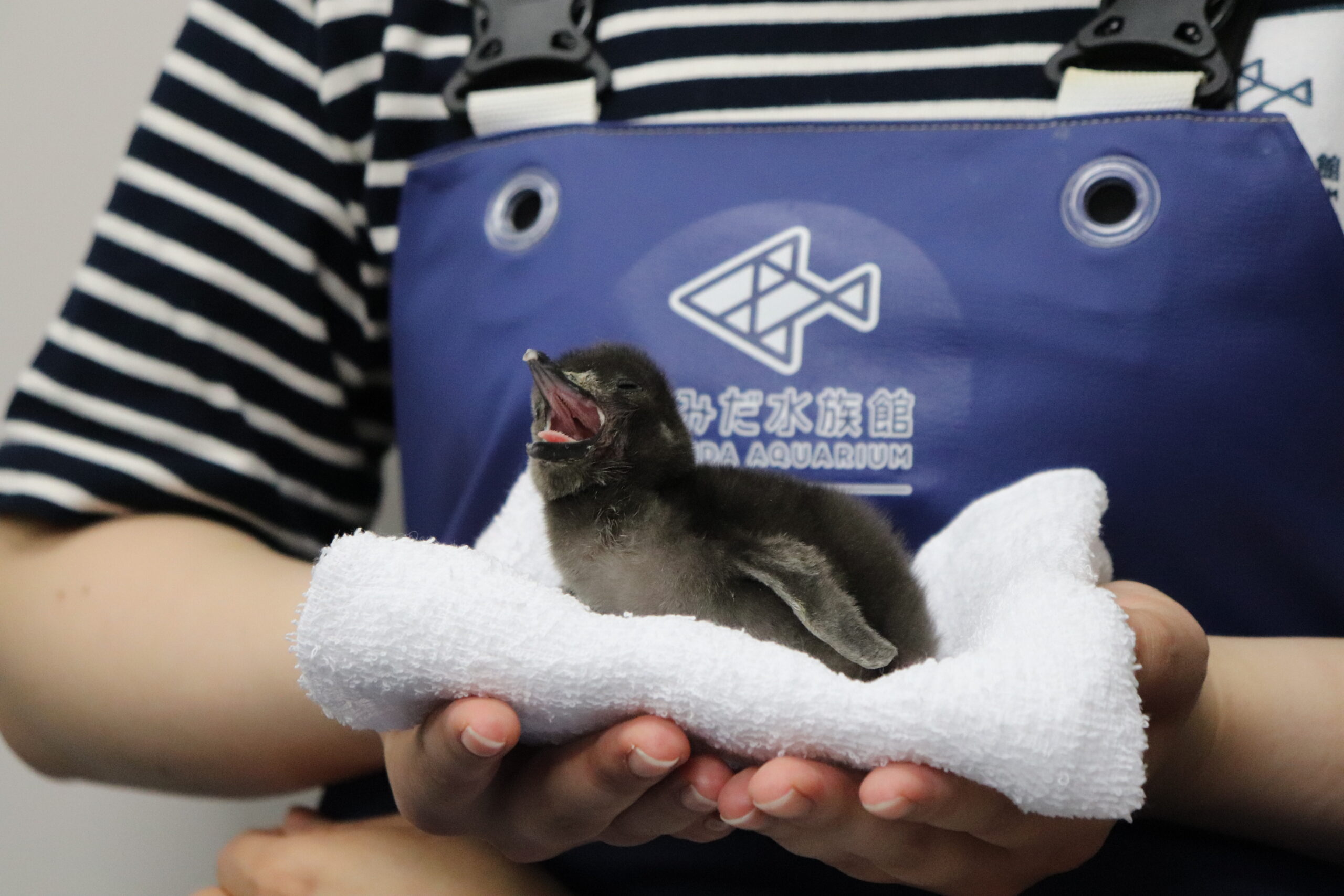
Since Sumida Aquarium opened in 2012, a total of 27 Magellanic penguins have been born. The breeding season for penguins at our aquarium runs from December to May. They begin to build up their bodies around December, lay eggs around March, and the chicks are born around May. The breeding season is upon us again this year. In this column, we will explain how our penguins are born and the preparations that go into that process. (Takashima Yukari, Exhibit and Breeding Team)
■Letting children experience the change of seasons (around December)
In the previous column*, we mentioned that the breeding season for Magellanic penguins in the wild (Argentina) begins around September, so some of you may be wondering why the breeding season at aquariums begins in December. The reason why it differs from the wild is because the air temperature, water temperature, and sunlight conditions change with the seasons.
Magellanic penguins begin preparing for breeding by sensing the transition from autumn to winter. In Japan, these environmental conditions overlap around December, so at Sumida Aquarium, breeding preparations begin at this time. Furthermore, to help the penguins, who live entirely indoors, experience the seasons, we meticulously manage water temperature and lighting hours to create a comfortable environment. Water temperature is kept at its coldest throughout the year in December and January, gradually warming from February onward. To help the penguins experience the seasons through daylight hours, we adjust the lighting to split the dark hours into two periods: long and short. This adjustment allows them to sense the seasons, and ensures that all penguins experience not only the breeding season but also their molting period, in which they shed all their feathers, at the same time.
*Previous column: [Field trip report] Experiencing the life of Magellanic penguins in Argentina


penguins Pool Day and Night
■ Courtship season (around December)
From around December, the aquarium becomes lively with the calls of penguins. Changes in the behavior of males in particular can be seen; they call more, eat more, and get bigger. When a male calls on land, the female will quickly approach him, even if she is swimming, and the two birds will loudly call out to each other, echoing throughout the aquarium. When one pair calls, it often stimulates other pairs to join in, and a chorus of songs begins. When you see this behavior, you can sense the change of seasons and it is proof that the penguins' breeding season has arrived safely.

Akebia chirping next to his wife Fuji
Incidentally, in the wild, during breeding season, the male returns to the nest first and waits until the female returns. They spend the six months outside of breeding season in different ocean currents, so it's been about six months since the male and female last met during breeding season. There is no set date or time for the reunion, but it feels mysterious that they can meet again in the nest they spent six months in.
■ Research into breeding season behavior using pair-watch sheets (January to April)
From December onwards, when breeding season begins, pairs spend more time together. As of February 2025, there are 18 pairs at Sumida Aquarium, and each pair has different behavioral patterns, ranging from "types that stay together all day except when feeding" to "types that spend a lot of time together at night." To understand the characteristics of each pair, provide care to encourage breeding, and help with health management, we conduct an annual survey using a checklist called a "pair watch sheet."

Pair Watch Sheet
Nine items, such as "acting together" and "preening their feathers," are surveyed during the day and at night. The survey results are used as a source of information for deciding care policies and are also used to understand trends for the year, such as whether care is being provided properly. Depending on the pair, all items may be filled in as the egg-laying season approaches.
Additionally, as young individuals begin to search for mates, the relationships between them will change. The details of whether or not they are interested in breeding with the opposite sex and who they will choose are of great interest to the animal care staff, so they are also investigating immature individuals that are not yet of breeding age. They understand the distance between these individuals and, in some cases, even help them form pairs.

Bonbori and Daifuku are often seen together (they are not a pair)
■Nest provision (around February)
Around February, when the pair have bonded and the female has eaten well and is physically prepared for egg-laying, the backyard is redecorated for breeding so that the penguins can lay their eggs in peace.
penguins will not mate or lay eggs unless they are in a safe and secure place. For this reason, nests are handcrafted by the animal care staff to suit each pair, with space reserved for just the two of them. Aiming to provide a better environment, the nests have been repeatedly improved, combining materials such as artificial turf and vinyl pipes.

Breeding-spec backyard
■Holding Nest Previews <br />We hold "previews" (as they are commonly called) with the idea that letting the birds choose their favorite nest spot might deepen the bond between them. Pairs that have been together for a long time tend to have a favorite spot to a certain extent, but there is still drama before the spot is decided, with the birds sometimes checking out all the spots together, or the male and female sometimes liking different spots and engaging in silent battles, or the pair sometimes liking two spots and fighting with each other. For us animal care staff, the "previews" are one of the times we look forward to every year.

penguins choosing a nest
■Providing nesting material <br />By engaging in nesting behavior, the male becomes more attached to the nest, and the female decides whether it is a suitable place to lay eggs. Therefore, once the viewing has calmed down to a certain extent and she has decided on a place she likes, she provides straw to use as nesting material.
The males compete to be the first to carry the straw. There are individual differences in how they carry it, either picking up a large amount in their beaks or dropping it as they walk, so in the end, some can only carry short strands of straw to the nest, some can only carry one strand at a time, and some want to steal the straw from the neighboring pair.

animal care staff handing out straw
The female, waiting in the nest, shakes her head in delight when the male brings straw. In this way, a safe place has been decided, and when she sees the two birds sleeping close together in the nest, she feels a sense of relief and joy.

Relaxing Watermelon and Sakura
In their natural breeding habitats, they also carried straw-like plants like the ones we were giving them.Similarly, we saw some heartwarming behavior, such as when they were carrying large amounts of plants, and other times when they only had about three stalks.

Magellanic penguins in the wild carrying straw
■No need for a map!?
Once they've chosen a spot, the penguins remember it well, and when they return to the backyard from the pool, they run straight back to their rooms.
I was also amazed by the homing instinct of penguins in the wild. They head straight for their nests without getting lost, even in vast areas where it's difficult to find landmarks. According to local researchers, they are still studying what landmarks the penguins use to find their nests. It would be very interesting to find out.
■To strengthen the bond between pairs , we use the information on the "Pair Watch Sheet" to create strategies to make life easier for the pair and prevent them from getting into a rut. By providing care tailored to each pair, such as "deliberately making time to live apart," "spending time together only at night," or "swimming and eating together," this will lead to them exchanging calls and mating behavior when they reunite. Each pair expresses their joy at reunion in different ways, expressing their emotions with their bodies by puffing up their feathers, wriggling their bodies, exchanging calls, flapping their wings, and initiating mating. It's heartwarming to see them expressing their affection.

Apricots and macarons that stick together perfectly
The birds we are most concerned about are "Ajisai" and "Choco." They had difficulty finding the right timing for mating, and were unable to produce fertilized eggs. When we attached a pair-watch sheet to them, we discovered that birds that spend a lot of time together tend to mate more frequently. So, we made sure to keep them together even during regular checkups, and now they are consistently producing fertilized eggs. Then, in 2023, their first chick, "Ame," was born.

Hydrangea and Chocolate
■ Hoping for the birth of a new life <br />The penguins will deepen their bonds and eggs are expected to be laid around March or April. We are making careful preparations in the hope of the birth of a new life. Having recently experienced firsthand the bonds between penguins in the wild and the hardships of raising children in Argentina, we want to approach the breeding of the penguins with even more love.
Column List