column


Fish have arrived from the Ogasawara Islands! A report on a journey of approximately 1,000 km
- Behind the aquarium
The Ogasawara Sea Life is currently home to approximately 450 fish from around 45 species, including the grey nurse shark, a species that has only been confirmed to live in the waters around the Ogasawara in Japan. These fish are collected by Sumida Aquarium staff who travel directly to Ogasawara Village. In this column, we'll meet the fish on-site in the Ogasawara Islands and tell you how they make their way to Sumida Aquarium from the ocean some 1,000km away!
Collection plan for fish swimming in the Ogasawara Sea Life <br />The Ogasawara Large Aquarium is home to approximately 450 fish of 45 species that can be found in the waters of the Ogasawara Islands. Some fish have been there since the aquarium opened, but some species are becoming less abundant due to their lifespan. Therefore, on January 23, 2023, the fish swimming in the Ogasawara Sea Life inside Sumida Aquarium were replenished. This is the third time since the animals opened that a collection has been carried out to replenish the fish in the large aquarium. For the first time in three years, approximately 200 fish were collected so that we can share the underwater scenery of the Ogasawara with everyone.
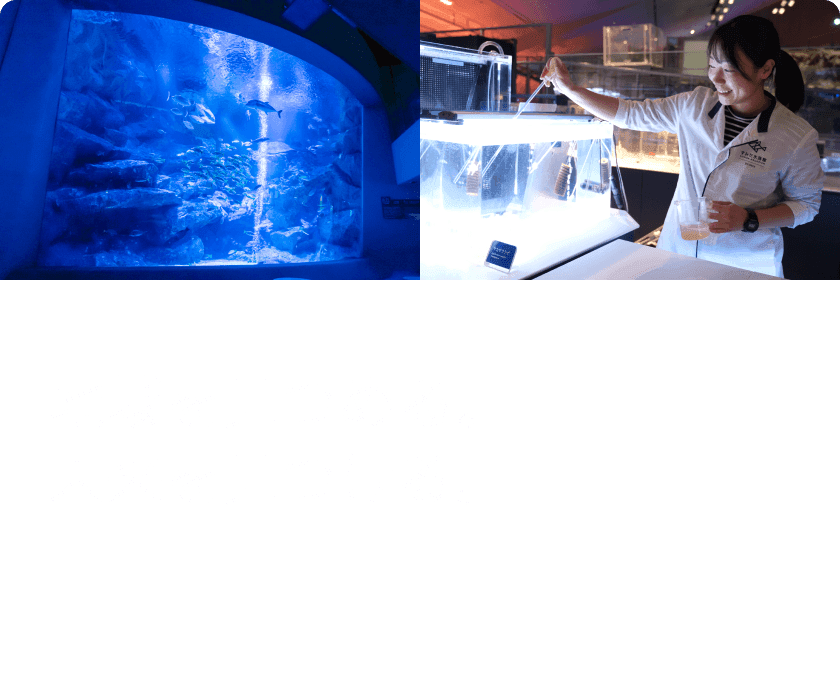
The Ogasawara Sea Life , which depicts the ocean of the Ogasawara
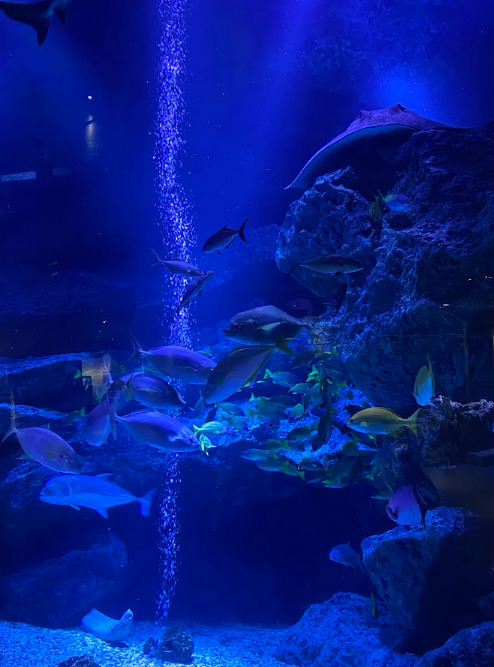
Since its opening in 2012, Sumida Aquarium has partnered with Ogasawara Village in Tokyo to carry out a variety of activities. As part of these activities, the Ogasawara Sea Life is designed to help visitors learn more about the oceans of the Ogasawara, Tokyo's only World Natural Heritage Site. The aquarium has received cooperation and advice from various parties in Ogasawara Village regarding the underwater scenery, with the aim of promoting the Ogasawara' unique deep, blue, and crystal clear waters known as "Bonin Blue." Visitors can see approximately 450 fish from 45 species that have come from the Ogasawara Islands.

< Ogasawara Sea Life>
We even caught the rare pure white barracuda! We carefully caught about 200 of them, one by one. Many fish live in the waters around the Ogasawara Islands. Our first target this time was the barracuda, a fish that is rarely seen elsewhere but for some reason appears in the Ogasawara Islands in many different colour variations. It is usually greyish in colour, but there is a high probability of bright yellow individuals living in schools, making it a species that characterises the waters around the Ogasawara. Other fish that can be seen in abundance in the waters around the Ogasawara include schools of sawfish and large fish such as black porgy.
Fish are collected using fishing rods. Using nets often injures the surface of the fish's body, so the approximately 200 fish are carefully fished out one by one. Depending on the water depth, when the fish are pulled up, the air in their swim bladders expands due to changes in air pressure, making it impossible for them to sink. In such cases, care is taken to quickly release the air from the swim bladders on board.
The collection took place on board a ship over a period of six days, with great care taken to avoid damaging the animals.
As a result, we managed to collect about 200 fish, including the bright yellow Southern Barracuda, as well as a school of 100 Sawtooth Snappers. We were also able to collect a rare pure white Southern Barracuda, which is rarely seen even locally.

<Catching each fish carefully>

<School of sawfish>
Are you OK? Checking in while crossing the 1,000km ocean
The collected fish are transferred to large tanks on site, where they are fed, cleaned, and their health monitored for a period of time, just as they would be at the aquarium. Then, on the day of departure from Ogasawara Village, they are transferred to a transport tank and finally set off on the ferry. Even though they are still in Tokyo, the crossing takes 24 hours, and the condition of the fish in the tanks and the water temperature are checked every few hours as they cross the approximately 1,000km ocean.

<Be cautious and check your health>

<Aboard the container to the Ogasawara Maru!>
Everyone is in good spirits and we arrive at Sumida Aquarium!
After about 24 hours of waiting, the ferry finally arrived, and the fish were then transferred to the tanks in a live fish transport vehicle for transport from the port to Sumida Aquarium. Looking at them from the side, the fish all looked healthy! However, they were likely tired from the long journey, so it was a race against time from this point on. The aquarium animal care staff joined us, and six of us checked on each fish one by one, moving them quickly while being careful not to injure them. Once they were placed in the live fish transport vehicle, they were swiftly sent to Sumida Aquarium.
Once they arrive at Sumida Aquarium, all the animal care staff work together to transfer the fish to the Ogasawara Sea Life. At this point, it has been approximately 26 hours since they left Ogasawara Village. It is a race against time to ensure they are all healthy and can be transferred safely to the large tank. They are quickly moved from the live fish tank to a mobile container that will take them to the large tank! Once the container is brought close to the tank, they are transferred into the large tank in a relay system. When transferring, they are all first moved into a separate enclosure separated by netting so that the fish can gather together in a safe and secure environment, even in a new environment. After being placed in the enclosure, they are observed for a while to see if they are settling down.

<Everyone is doing well!>

<Rare white southern house thrush>
Finally, we head to the Ogasawara Sea Life!
Finally, they were released from their enclosures into the Ogasawara Sea Life! The animal care staff were very nervous, wondering if the fish would be chased by the original fish, and whether they would be able to stay together in a calm group. However...once released into the large aquarium, the fish began to swim vigorously, quickly joining up with the other fish of their respective species, the fish that had been living at Sumida Aquarium and the new fish that had arrived from the Ogasawara Islands all swimming together. The staff who were watching this scene looked relieved, and gazed at the fish swimming energetically for a while. The staff who had traveled to the site to collect the fish also breathed their first sigh of relief at the sight of the fish that had traveled with them swimming safely in the large aquarium.
The pure white barracuda, which was the first to be welcomed into Sumida Aquarium, also joined the school without incident. The yellow barracuda and the more impressive school of sawfish further enhanced the underwater scenery of the Ogasawara.

Sumida Aquarium hopes to continue its efforts to communicate the natural wonders of the Ogasawara, the only World Natural Heritage site located in Tokyo.
Please come and meet the fish that have come from the Ogasawara Islands!
Fish that arrived from the Ogasawara Islands this time

[Southern barn thrush]
They live in schools on rocky reefs. They are usually gray, but many yellowed individuals have been spotted around the Ogasawara.
Favorite spot in the aquarium: They are often found in groups at the back of the upper layer of the tank.

[Sawtooth dai]
This is one of the typical schooling fish found in the waters around the Ogasawara. Because of their large eyes, they are locally called "Medama" (a local name). Favorite thing about the aquarium: They swim in schools in the upper layers of the tank.

[Cappore]
This fish is characterized by its long, protruding dorsal and anal fins. It is also a popular target for fishing, and is a familiar fish from the Izu Islands to the Ogasawara Islands.
Favorite spot in the tank: It swims near the middle of the tank. It's large, even in a large tank, so it has a strong presence.

[Old man]
It has two whiskers on its lower jaw, and its name comes from the fact that it looks like an old man (with a beard). There are many other species with these distinctive whiskers in the Ogasawara Islands, but this old man is particularly common.
Favorite spot in the aquarium: They are often seen swimming in groups at the bottom.

[Blue-striped triggerfish]
Its name comes from the thin blue line that runs down the center of its body. It is widely distributed in warm oceans overseas, but currently it can only be found in certain areas of Japan, including the Ogasawara Islands.
Favorite spot in the aquarium: They often swim around in different places.
Column List