column


Learn more about Magellanic penguins! ~Behavioral research using data loggers~
- Introducing the animals
- Research and studies
Aquariums are places where you can get up close and personal with the diverse animals that live there. Through the animals, Sumida Aquarium not only gives visitors a sense of excitement and relief, and an opportunity to reflect on the importance of life, but also conducts a variety of surveys and research.
In this column, we will introduce one of the research projects conducted by Sumida Aquarium.
Making the lives of Magellanic penguins healthier and more prosperous
Sumida Aquarium has been raising Magellanic penguins since it opened in 2012. They have been successful in breeding for 10 consecutive years, and many penguins have been born. Although some have moved to other aquariums, as of August 2022, the aquarium has a large population of 52 penguins. The "penguins Relationship Chart," which shows their relationships at a glance, has also served as a catalyst for introducing visitors to the many charms and ecology of penguins, including their personalities and sociality.

Five babies were born in 2017

Nadeshiko and Lime, a married couple who have been with us since the store opened
On the other hand, we believe that whether the penguins, who cannot communicate through words, feel that "this is a comfortable place to live" is reflected in the fact that breeding has continued uninterrupted for 10 years and the parent penguins remain healthy. This is the result of the animal care staff, who are in closest contact with the penguins, continually spotting small changes and making improvements. However, in order to further improve the quality of life, we need to gather more messages from the penguins, such as how they feel about their current lifestyle, whether they have any complaints, or whether anything is affecting their health.
For example, we could observe them 24 hours a day, 365 days a year, to see what changes in their behavior occur depending on how they spend their nights, the seasons, whether they are male or female, or whether they are in a relationship, and consider whether their behavior is good or bad. However, our observational skills vary from person to person, making it impossible to make continuous and accurate observations.
Therefore, as a basic study to record the behavior of penguins more accurately, which is difficult to observe with human eyes alone, and to help them live healthier and more fulfilling lives, we decided to start recording the behavior of penguins using a recording device called a "data logger" in collaboration with Professor Yamamoto of Azabu University, who is continuing to conduct behavioral research in penguins, where penguins penguins live.
Could researching life in aquariums lead to wildlife conservation?
Comments from Professor Yamamoto
Have you ever heard of the term "biologging"? To learn about animals, we need to carefully observe their behavior. However, there are limits to the amount of time and number of individuals we can observe. Therefore, "biologging" is a method of studying their behavior by attaching small devices called "data loggers" to animals. It might be helpful to imagine a smartwatch as an example. For health management, we record the number of steps we take and the calories we burn each day to use as clues for improving our lifestyles. In the same way, recording and analyzing penguins' behavior with data loggers is expected to lead to health management and early detection of illnesses. There is also much we can learn about penguins, such as their daily behavior patterns. We can learn about their lifestyles and individual personalities. Furthermore, comparing their behavior with that of penguins individuals can provide clues for considering captive environments that more closely resemble their natural environment.
Meanwhile, learning about the behavior of captive penguins can also contribute to research on penguins in the wild. For example, by understanding the behavioral characteristics of Magellanic penguins, such as individual differences in behavior, differences between sexes and ages, and differences in behavior between breeding and non-breeding seasons, we may be able to predict the impact of global warming and other factors. By studying the behavior of the penguins at Sumida Aquarium, we hope to not only help them live a better life, but also contribute to the conservation of wild penguins.
Takashi Yamamoto (Associate Professor, Department of Applied Animal Science, School of Veterinary Medicine, Azabu University)
Using data loggers, he studies the ecology of birds and mammals not only in Japan but also around the world. He is interested in the way animals live in relation to their environment (adaptation), and is investigating the relationship between environmental change, global warming, and human activity. His specialty is animal behavioral ecology. In recent years, he has conducted research at a Magellanic penguins breeding ground in Argentina. He also attaches data loggers to animals kept in aquariums and zoos in Japan, and is engaged in research on behavioral monitoring and environmental enrichment.

Professor Yamamoto conducting research at the Magellanic penguins breeding grounds (San Lorenzo) in Argentina.
About attaching a data logger
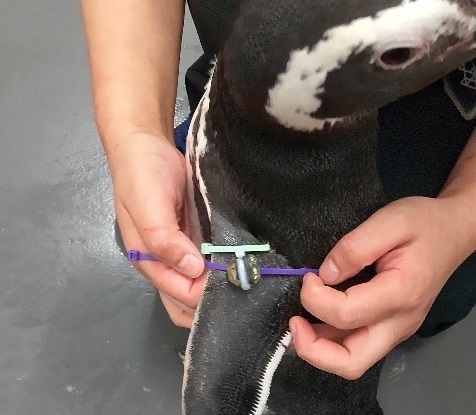
As shown in the photo below, a device (data logger) will be attached to the bands on the penguins' flippers (wings), and the study will be conducted for one year. Behavioral research using data loggers has been conducted on many wild penguins, and in recent years has also been conducted in zoos and aquariums overseas. Preliminary tests at Sumida Aquarium have confirmed that there is no impact on the penguins, so please rest assured.
One of the important roles of an aquarium is to cooperate in research and surveys into the ecology of animals that are still being studied. At Sumida Aquarium, we are mindful of animal welfare and strive to realize a better life for animals, and we would like to continue to cooperate and take part in initiatives that also contribute to wildlife conservation and environmental protection.


Column List